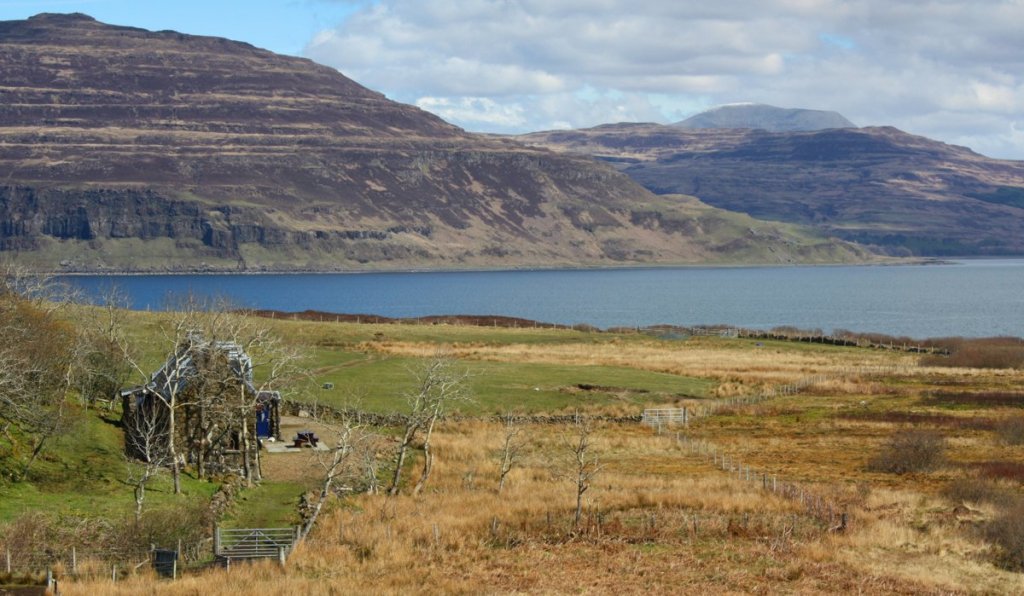
Carbon and sustainability may not be the reason why you choose a holiday cottage, it’s more likely views and location? But at Torr Na Locha where we are blessed with both anyway it’s something we have been increasingly giving some thought to.
By choosing to stay in the UK and visit the Isle of Mull you will have already saved around 275KG of CO2 each as opposed to flying to Majorca so if there are 4 of you staying that’s just over a Tonne saved, the image above shows just 1 days global flights in 2019 with more than 162,637 take offs recorded. But what is the impact of the occupation of the building on the planet?
In 2022 the croft used 15,150 KW/H which was sourced from Bulb, this compares to the average of 5,000 KW/H for an average UK house, this reflects the age and construction of the cottage and whilst we have insulated inside the solid walls and the loft spaces maintaining the cottage at a comfortable temperature for day round occupation will always be higher than a new build property.
There is no Natural Gas on the island, and Electricity is the most popular form of heating with Oil as a second. We buy our electricity from Bulb who source purely from renewables at 0.193 KG per KW/H which produces 2,925 KG or 2.925 Tonnes of CO2, this compares to around 6.5 Tonnes if average UK electricity suppliers were used, or 4.6 Tonnes if we switched to Oil.
That’s good but we want to do better.
After much research we are installing a Wood Burning Stove with a back boiler that will output up to 21KW of heat. To fuel the fire we have sourced local timber from the island from a forestry contractor, the trees in question cannot be used for structural timber as they are either blown over by wind or too small or bent. From our research this timber due to its reduced shipping miles will only produce 4g of CO2 per KW/H reducing the carbon footprint of the cottage to around based on around 78% of the electricity we use going to space and water heating (based on logged data from 2022) to around 475 KG or roughly 0.5 Tonne.
This still leaves around 3350 KW/H for lighting and cooking which accounts for another 650KG or 0.65 Tonnes, however in 2022 we generated 3,650KW from the solar array which was fed back into the grid which means we saved 120 KG of CO2 needing to be generated from Gas or other fossil fuels.

That gives us a potential net Carbon footprint for domestic energy of 355KG of CO2 Per year in 2023. We realise guests may not wish to light the wood burner and will be leaving in the existing Electric Boiler for the Radiators and the Hot water as a back-up or for those who like a soak in the bath with a view over the loch in the summer without having the fire lit in the kitchen (the showers are electric so they will always be hot anyway). We just want to give people the option and if like us keeping half an eye on your Carbon Footprint you can choose to, or you may just love that cosy glow and curling up with a book in the kitchen.
That accounts for the Carbon Dioxide we produce from occupying the House but what about the croft itself? We have about 1.25 Hectares of tree planting on the croft, the majority of which is ancient Atlantic Rainforest with Oak, Birch, Aspen and Willow making up the mix. This tree belt sits behind the cottage in a vertical band, working with the Woodland Trust we are managing this through selective thinning and reinforcement planting to improve its health and resilience. This woodland makes up part of the patchwork of smaller woods across Mull and in its own right stores about 170 Tonnes of CO2 per year with around 60 Tonnes from the trees and 110 Tonnes from the soils.
In addition to the trees what is under the ground on the wet bits is even more fascinating, many visitors will have experienced that sucking feeling of losing a welly or walking boot to the wet mossy ground in front of the cottage. On the croft we have around 1.8 Hectares of active peat bog which is around 4m thick, laid down over millennia (the first evidence of human occupation on the site comes from an arrowhead found from 2500BC on the far edge of the Loch). Estimates vary as the science is still evolving but research suggests restored and managed Peat Bogs can capture and store up to 1500 Tonnes of Carbon per Hectare per year, 500 times more than is currently generated in using the cottage.
Finally again in collaboration with the woodland Trust we have also looked at the hill or Torr in Gaelic (Hence the name Torr Na Locha) which on first inspection appears barren heather. Closer investigation shows a continuation of the species from the steep woodland running over the hill but the constant grazing from Deer of the young shoots in spring means it cannot regenerate. This is evidenced by the thick stems below the heather line which can be felt showing the trees are healthy and have been there for many years, Fencing of the whole area or even parts would allow the trees to regrow and to provide both Carbon storage but a larger area of bio diverse habitat extending the Atlantic Rainforest with its trademark mosses and fungi supporting wildlife and linking up with other woods to provide corridors for animals and insects. The headland is around 2.9 Hectares so again regenerated woodland on this could absorb another 300 Tonnes of Carbon annually with regeneration occurring quickly once the grazing is stopped. The problem is Deer fencing is expensive and this will form part of the longer term goal and management of the Croft hopefully for future generations to enjoy.
 Torr Na Locha